Webhook
This is the way out for the channels with Webhook switched on: where their posts are handed over, how whatever receives them proves they came from Reelwire, and a log of every hand-over, by email and by webhook alike. You find it under Connections, then Webhook; it used to be called Publishing. It is an admin's screen, and it is separate from API keys on purpose. A key goes into the script that sends data in. What is on this page goes into whatever receives posts going out. The two are set up at different times by different people.
Reelwire posts nothing itself. When a post is due it is handed over, by email, by webhook or both, as each channel says under Channels, and whoever receives it posts it: your own script, an automation or a posting service behind the webhook, or a person reading the email. A channel handed over by email only needs nothing on this screen, and its letters still show in the log at the bottom.
The Guides chapter has a guide for each kind of receiver: Handed over by webhook.
Your webhook address
The card Set your webhook address sets the one address the whole workspace's webhook calls go to, and shows how a receiver proves they came from Reelwire. Every kind of call goes there: a post to hand over, a change to one, a request to take one down, and a test. A post going to several channels with Webhook switched on arrives as one signed call carrying every channel of the batch. Webhooks has what a call carries, how to answer it and how to report back once a post is up.
The signing secret is all a receiver needs: every workspace has its own, so a delivery that verifies with it is from this workspace. How to check it, header by header, is in Webhooks.
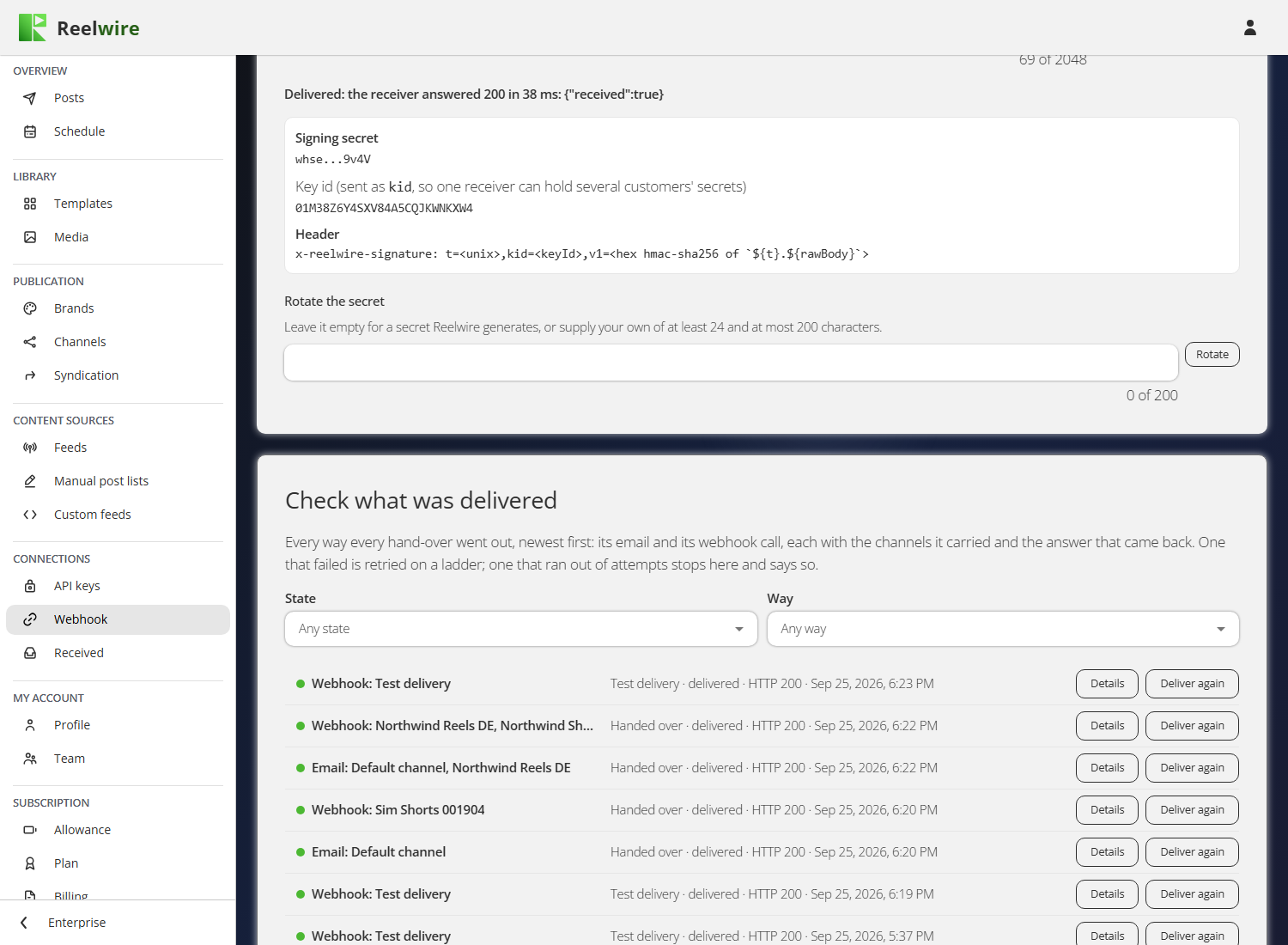
Test delivery, beside Save, sends a signed test call to the saved address now and says what came back, in a green box ("Delivered: the receiver answered 200 in 184 ms") or a red one ("Not delivered." and why; where the receiver refused the signature, a reminder that it needs this workspace's current secret). It arrives exactly as a real hand-over does, about no post, so a receiver's signature check can be tried before a real post reaches it. It is offered once the address is saved, not while the field holds a change you have not saved, and every test is a line in the log below.
The signing secret sits in a panel of its own, showing only its start and end. Rotate the secret, the full-width button at the foot of the card, opens a dialogue that says what rotating breaks before anything happens, and Reelwire makes the new secret. It then opens in a dialogue of its own, shown once and never again, with Copy. It takes effect on the next call: anything still verifying with the old secret starts rejecting until you update it, so rotate when you can deploy the new secret, not before.
Checking what was delivered
The card Check what was delivered lists every way every hand-over went out, newest first: a line for its email and a line for its webhook call, each naming the channels it carried. Each line says what it was (handed over, a change, asked to take down, or a test delivery), where it stands (queued, sending, delivered, retrying, or gave up), what came back, how many attempts it took and when. One that fails is retried on a ladder; one that ran out of attempts stops there and says so.
It is the same table as every other log: a period to show (this week at first), a search over the channels' names, the error and the address a line went to, State, Way and What to narrow it, an order (created or last attempt, newest or oldest first) and pages. It refreshes itself every few seconds.
Details opens one line whole: where it went (the webhook address, or, for an email, the owner and everybody holding Operations), the channels it carried, where it stands after how many attempts, the channels of the post it left out and why, the hand-over and the post it belongs to, what came back, and what it carried, exactly as it last went out.
Deliver again is offered on every line, delivered ones included, because the usual reason to want it is that the receiver lost the post rather than that Reelwire failed to send it. A webhook call goes again with the same delivery id, so a receiver that de-duplicates on it correctly ignores one it already has; an email goes again as the same letter. A post whose every way out gave up reads POST FAILED on Posts; delivering it again hands it over again, and it reads HANDED OVER once it gets through.