Activity
Everything through Reelwire, in two cards: What came in, every event that arrived from a feed, a post list or a custom feed and what Reelwire decided about it, and under it What went out, every way every hand-over left and what came back. It is a record, not a queue: nothing here is waiting to be handled. You find it under Connections, then Activity, because it answers whether what you just wired up arrived, and whether what Reelwire handed over got through. It needs the Operations permission; Deliver again on What went out needs Administration as well.
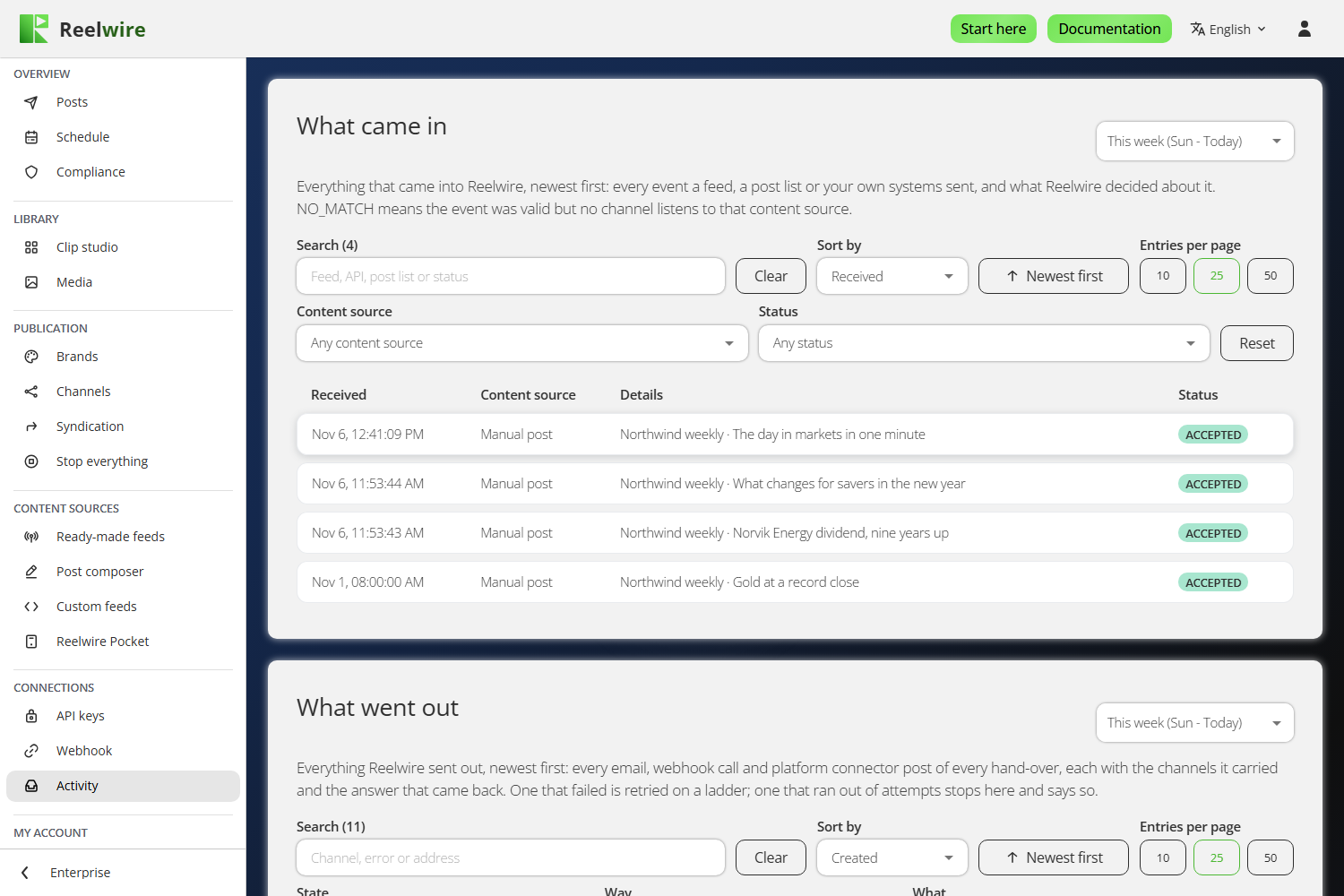
What came in
The events worth reading here are the ones that made no post. Everything that did make a post is on Posts, which is the better screen for following it.
Each row says when the event was received, its content source (Ready-made feed, Manual post or Custom feed), which feed, stream or post list it came through, and its status.
| Status | What it means |
|---|---|
| ACCEPTED | The event was valid and at least one channel listens to its content source, so posting jobs were made from it. |
| NO_MATCH | The event was valid, but no active channel listens to this content source, so nothing was made from it. |
| STALE | The event happened too long ago for this feed to post about, so it was logged and nothing was made. |
| DUPLICATE | An event with this id already arrived, so this one was ignored. |
| UNMAPPED | The event arrived on a custom feed, but its data did not fit what the stream's template accepts, so nothing was made. |
NO_MATCH is the one to look for. It almost always means a channel is not subscribed to the source you thought it was. Open Channels, press Sources on the channel, and check the source is there and not paused. A paused channel, or a channel whose brand is paused, does not count as listening.
DUPLICATE is usually correct rather than a fault: Reelwire ignores a repeated eventId so a
producer can retry safely.
The period
The screen opens on This week (Sun - Today) rather than today, because today is empty at one in the morning and an empty board reads as a broken one. The window is worked out from your own clock, so "Today" means your day. If something you sent is not listed, widen the period before assuming it did not arrive.
Filter by content source or status, search by feed, stream, post list or status, and sort by when it was received, by status or by content source. The list refreshes itself every few seconds.
What went out
The card What went out, under What came in, lists every way every hand-over went out, newest first: a line for its email and a line for its webhook call, each naming the channels it carried, and a line for each post a platform connector made (Way: Platform connector). Each line says what it was (handed over, a change, asked to take down, or a test delivery), where it stands (queued, sending, delivered, retrying, or gave up), what came back, how many attempts it took and when. One that fails is retried on a ladder; one that ran out of attempts stops there and says so.
It is the same table as every other log: a period to show (this week at first), a search over the channels' names, the error and the address a line went to, State, Way and What to narrow it, an order (created or last attempt, newest or oldest first) and pages. It refreshes itself every few seconds.
Details opens one line whole: where it went (the webhook address; for an email, the owner and everybody holding Operations; for a platform connector, what it posted as), the channels it carried, where it stands after how many attempts, the channels of the post it left out and why, the hand-over and the post it belongs to, what came back, and what it carried, exactly as it last went out.
Deliver again is offered to whoever holds Administration, the permission the Webhook screen needs too, on every line, delivered ones included, because the usual reason to want it is that the receiver lost the post rather than that Reelwire failed to send it. A webhook call goes again with the same delivery id, so a receiver that de-duplicates on it correctly ignores one it already has; an email goes again as the same email. A green note above the table says what was queued again. A post whose every way out gave up reads POST FAILED on Posts; delivering it again hands it over again, and it reads HANDED OVER once it gets through.
A platform connector's line is the exception once it got through: the platform has the post, and it would take it a second time, so Deliver again is not offered there. A connector line that failed, a wrong token put right since, for example, can be delivered again like any other.